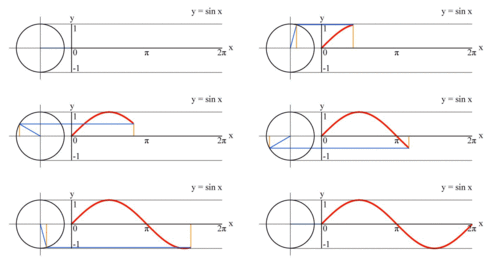
Trigonometry News, Math News, TrigonometryII, algebraic,equations


Trigonometry News, Math News, Trigonometry II, algebraic,equations

Trigonometry101.Com

Engineering, Careers, Jobs

Quadratic, Algebraic Equations

Angles, Curves, Measurements

Trigonometry and Math News

Filter= Hypotenuse


  Exact Time


 * Search on anything here:         Like us:      Follow us:   


 * Featured New Sites! =>


* Z101.COM *


** Useful Links **
  • Obituaries101
  • Accident Lawyers101
  • FIRE101
  •  FIRE101 MOBILE
  • POLICE101
  • Protect101
  • School Directions
  •  

  • ** Car Websites **
  •   Corvettes 101
  •   Mustangs 101
  • New Cars 101
  • Luxury Cars 101
  • Exotic Cars 101
  •  

  • ** Sports Websites **
  • Lacrosse 101
  • Volleyball 101
  • Cross Country 101
  • Rowing 101
  • Rugby 101
  • Softball 101
  • Water Polo 101
  • Karate 101
  • TKD 101
  •  

  • ** Medical Websites **
  • Internal Medicine 101
  • Sports Medicine 101
  • Nursing 101
  • OccupationalTherapy101
  • Orthopedics 101
  • Podiatry 101
  • Psychiatry 101
  •  

  • Diseases 101
  • Depression 101
  • Lyme Disease 101
  • OCD101
  •  

  • ** Lawyers Websites **
  • * Find Lawyers 101 *
  • Accident Lawyers 101
  • Defense Lawyers 101
  • Divorce Lawyers 101
  • DWI Lawyers 101
  • Malpractice Lawyers 101
  • Personal Injury Lawyers 101
  • Real Estate Lawyers 101
  • Tax Lawyers 101
  •  


    * Trigonometry101 SEARCH *

    *Filter: "Hypotenuse"      


    Hypotenuse - Wikipedia
    A right-angled triangle and its hypotenuse In geometry, a hypotenuse is the side of a right triangle that is opposite to the right angle. [1] It is always the longest side of the triangle. The other two sides of a right triangle are called legs or catheti. [2][3]

    Hypotenuse Calculator
    With this hypotenuse calculator, you will quickly find the longest side of a right triangle. If you want to know the hypotenuse of a right triangle and how to find it, you'll discover the answers below, along with a simple example to clarify things.

    Hypotenuse of a Triangle – Definition, Formulas - Math Monks
    To find the hypotenuse of a right triangle when the length of a side and its opposite angle are known, we use the given formula, which is called the Law of sines.

    Right Triangle Calculator
    In a right triangle, the side that is opposite of the 90° angle is the longest side of the triangle, and is called the hypotenuse. The sides of a right triangle are commonly referred to with the variables a, b, and c, where c is the hypotenuse and a and b are the lengths of the shorter sides.

    Hipotenusa
    Aquí encontrarás qué es la hipotenusa de un triángulo rectángulo, cómo se calcula (fórmula) y ejercicios resueltos paso a paso.

    Hypotenuse - Math.net
    Since the hypotenuse of a right triangle is the longest side of the triangle, the 90° angle opposite it is also the largest angle of the right triangle. This also makes sense because the internal angles of a triangle sum to 180°.

    HYPOTENUSE Definition & Meaning - Merriam-Webster
    The meaning of HYPOTENUSE is the side of a right-angled triangle that is opposite the right angle.

    Hipotenusa (matemáticas): ¿qué es?, ¿cómo se calcula?
    Información de qué es la hipotenusa, definición, significado, como hallarla con diferentes fórmulas, ejercicios con solución y más.

    calcul hypotenuse et formule de Pythagore - Calculatrice.com
    L’orthographe française correcte est hypoténuse, avec un accent sur le é. Les recherches hypotenuse, hypothénuse ou hypothenus désignent généralement la même notion.

    Hypotenuse - Meaning, Theorem | Hypotenuse of a Triangle - Cuemath
    Hypotenuse Definition: In a right-angled triangle, the longest side or the side opposite to the right angle is termed hypotenuse. The hypotenuse is related to the base and the altitude of the triangle, by the formula: Hypotenuse 2 = Base 2 + Altitude 2.


           * Trigonometry101 LATEST NEWS *

                        *Filter: "Hypotenuse"


  • New Jobs!!!
  • Obituaries101
  • FIRE101
  • POLICE101
  • PROTECT101
  • School Directions
  • * POPULAR:  
  • Democrats101
  • Republicans101
  • NewCars101
  • LuxuryCars101
  • CarbonCapture101
  • *Sponsored: *Teleflora Flowers GREAT Deals!


    *Click a bouquet and send it today:


        ~~> 30% Off Discount Page - ALL FLOWERS! <~~


    *More Savings: 
    Get well: 20%    Sympathy & Funeral: 20%


             Birthday: $15    New Baby 15% off    Anniversary 15% off
    Important Trigonometry Terms
    • Sine (sin): The ratio of the length of the opposite side to the length of the hypotenuse in a right-angled triangle.
    • Cosine (cos): The ratio of the length of the adjacent side to the length of the hypotenuse in a right-angled triangle.
    • Tangent (tan): The ratio of the length of the opposite side to the length of the adjacent side in a right-angled triangle ($\tan \theta = \frac{\sin \theta}{\cos \theta}$).
    • Cosecant (csc): The reciprocal of the sine function ($\csc \theta = \frac{1}{\sin \theta}$), representing the ratio of the hypotenuse to the opposite side.
    • Secant (sec): The reciprocal of the cosine function ($\sec \theta = \frac{1}{\cos \theta}$), representing the ratio of the hypotenuse to the adjacent side.
    • Cotangent (cot): The reciprocal of the tangent function ($\cot \theta = \frac{1}{\tan \theta}$), representing the ratio of the adjacent side to the opposite side.
    • Hypotenuse: The longest side of a right-angled triangle, located opposite the right angle ($90^\circ$).
    • Radian: A unit of angle measurement based on arc length, where $2\pi \text{ radians} = 360^\circ$ ($1 \text{ radian} \approx 57.3^\circ$).
    • Unit Circle: A circle with a radius of $1$ centered at the origin $(0,0)$ in the Cartesian coordinate plane, used to extend trigonometric functions to any angle.
    • Pythagorean Identity: The fundamental trigonometric identity derived from the Pythagorean theorem, expressed as $\sin^2\theta + \cos^2\theta = 1$.


    Industries That Use Trigonometry
    • Architecture & Civil Engineering: Calculates structural loads, roof pitches, bridge support angles, and land slopes to design safe buildings and infrastructure.
    • Aeronautics & Aerospace: Determines flight paths, wind drift angles, satellite orbits, and altitude trajectories for aircraft and spacecraft navigation.
    • Video Game Development & CGI: Renders 3D graphics, calculates character raycasting, models object collisions, and animates realistic movement using vector trigonometry.
    • Land Surveying & Cartography: Measures distances, elevation changes, and geographic boundaries across large areas using triangulation techniques.
    • Acoustics & Audio Engineering: Analyzes sound waves, models frequency harmonics, and designs soundproof spaces using sine and cosine wave functions.
    • Maritime & Ocean Navigation: Computes true heading, compass bearing, ocean current offsets, and celestial navigation coordinates for ships.
    • Electrical & Mechanical Engineering: Models alternating current (AC) voltage waveforms, electromagnetic fields, and rotational forces in motors and machinery.
    • Medical Imaging & Radiography: Reconstructs 3D cross-sectional images in CAT scans and MRI machines by calculating wave projection angles.
    • Astronomy & Astrophysics: Measures interplanetary distances, stellar parallax, and celestial movement relative to Earth.
    • Meteorology & Climate Science: Models global weather patterns, ocean wave dynamics, and solar radiation angles to predict climate and weather systems.


    Important Trigonometry Historical Events
    • Plimpton 322 Clay Tablet (c. 1800 BC): Records ancient Babylonian mathematical tables containing advanced Pythagorean triples, marking the earliest known use of right-triangle ratios.
    • Hipparchus Compiles First Chord Table (c. 150 BC): Earns the title "Father of Trigonometry" by calculating circle chord values to solve astronomical triangles and track planetary motion.
    • Ptolemy Writes the Almagest (c. 150 AD): Expands chord tables and spherical trigonometry principles, creating a comprehensive geometric framework that dominated astronomy for over a millennium.
    • Aryabhata Introduces the Sine Function (c. 499 AD): Indian mathematician defines jya (half-chord), shifting mathematical focus from full circle chords to the modern concept of sine.
    • Al-Battani and Islamic Golden Age Innovations (c. 900 AD): Islamic scholars formalize tangent, cotangent, secant, and cosecant functions, establishing trigonometry as an independent mathematical discipline.
    • Regiomontanus Publishes De Triangulis Omnimodis (1464): Produces the first European textbook devoted entirely to plane and spherical trigonometry, standardizing trigonometric methods for navigation.
    • Rheticus Defines Ratios on Right Triangles (1596): Defines trigonometric functions directly as ratios of triangle sides rather than circle chords, creating the modern textbook approach used today.
    • John Napier Invents Logarithms (1614): Revolutionizes trigonometric computation by simplifying complex multi-digit sine and cosine multiplications into straightforward addition and subtraction.
    • Leonhard Euler Unifies Trigonometry and Calculus (1748): Introduces standard function notations ($\sin, \cos, \tan$) and formulates Euler's formula ($e^{ix} = \cos x + i \sin x$), connecting trigonometry with complex analysis.


    Essential Trigonometry Formulas
    • Pythagorean Identity: $\sin^2\theta + \cos^2\theta = 1$
    • Tangent Identity: $\tan\theta = \frac{\sin\theta}{\cos\theta}$
    • Reciprocal Identities: $\csc\theta = \frac{1}{\sin\theta}$, $\sec\theta = \frac{1}{\cos\theta}$, $\cot\theta = \frac{1}{\tan\theta}$
    • Sine Angle Sum Formula: $\sin(A + B) = \sin A \cos B + \cos A \sin B$
    • Cosine Angle Sum Formula: $\cos(A + B) = \cos A \cos B - \sin A \sin B$
    • Sine Double-Angle Formula: $\sin(2\theta) = 2\sin\theta\cos\theta$
    • Cosine Double-Angle Formula: $\cos(2\theta) = \cos^2\theta - \sin^2\theta$
    • Law of Sines: $\frac{a}{\sin A} = \frac{b}{\sin B} = \frac{c}{\sin C}$
    • Law of Cosines: $c^2 = a^2 + b^2 - 2ab\cos C$
    • Tangential Pythagorean Identity: $1 + \tan^2\theta = \sec^2\theta$


    TRIGONOMETRY101.COM --- Trigonometry, Trigonometry News, Math News, Trigonometry II, algebraic,equations, Trigonometry Resources, Geometry101, Algebra101,+++

    Need to Find information on any math subject? ASK THE Trigonometry101 GURU!

     * Contact us:  support@z101.com


    Copyright 2007-2026  Trigonometry101.Com