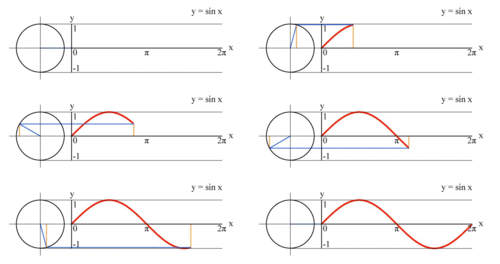
Trigonometry News, Math News, TrigonometryII, algebraic,equations


Trigonometry News, Math News, Trigonometry II, algebraic,equations

Trigonometry101.Com

Engineering, Careers, Jobs

Quadratic, Algebraic Equations

Angles, Curves, Measurements

Trigonometry and Math News

Filter= Symmetry


  Exact Time


 * Search on anything here:         Like us:      Follow us:   


 * Featured New Sites! =>


* Z101.COM *


** Useful Links **
  • Obituaries101
  • Accident Lawyers101
  • FIRE101
  •  FIRE101 MOBILE
  • POLICE101
  • Protect101
  • School Directions
  •  

  • ** Car Websites **
  •   Corvettes 101
  •   Mustangs 101
  • New Cars 101
  • Luxury Cars 101
  • Exotic Cars 101
  •  

  • ** Sports Websites **
  • Lacrosse 101
  • Volleyball 101
  • Cross Country 101
  • Rowing 101
  • Rugby 101
  • Softball 101
  • Water Polo 101
  • Karate 101
  • TKD 101
  •  

  • ** Medical Websites **
  • Internal Medicine 101
  • Sports Medicine 101
  • Nursing 101
  • OccupationalTherapy101
  • Orthopedics 101
  • Podiatry 101
  • Psychiatry 101
  •  

  • Diseases 101
  • Depression 101
  • Lyme Disease 101
  • OCD101
  •  

  • ** Lawyers Websites **
  • * Find Lawyers 101 *
  • Accident Lawyers 101
  • Defense Lawyers 101
  • Divorce Lawyers 101
  • DWI Lawyers 101
  • Malpractice Lawyers 101
  • Personal Injury Lawyers 101
  • Real Estate Lawyers 101
  • Tax Lawyers 101
  •  


    * Trigonometry101 SEARCH *

    *Filter: "Symmetry"      


    Symmetry - Wikipedia
    Symmetry (left) and asymmetry (right) A spherical symmetry group with octahedral symmetry. The yellow region shows the fundamental domain. A fractal -like shape that has reflectional symmetry, rotational symmetry and self-similarity, three forms of symmetry. This shape is obtained by a finite subdivision rule.

    Symmetry - Definition, Types, Examples, and Diagrams
    Symmetry In mathematics, symmetry is the property that divides a geometrical shape into two identical halves. Heart shape, an equilateral triangle, and a rhombus are all examples of symmetry. Such shapes are called symmetric.

    SYMMETRY Definition & Meaning - Merriam-Webster
    The meaning of SYMMETRY is balanced proportions; also : beauty of form arising from balanced proportions.

    Symmetry | Open Access Journal | MDPI
    Symmetry Symmetry is an international, peer-reviewed, open access journal covering research on symmetry/asymmetry phenomena wherever they occur in all aspects of natural sciences, and is published monthly online by MDPI. Open Access — free for readers, with article processing charges (APC) paid by authors or their institutions.

    Symmetry - Math is Fun
    Symmetry is when a shape or object looks exactly the same after a certain move, such as a flip, slide or turn. The simplest symmetry is...

    Symmetry - Get an Aesthetic Physique Naturally
    Get Symmetry for free on iOS and Android. Build an aesthetic physique with personalized training plans, automatic progressive overload, and workout tracking.

    Symmetry (geometry) - Wikipedia
    Reflectional symmetry, linear symmetry, mirror symmetry, mirror-image symmetry, or bilateral symmetry is symmetry with respect to reflection. [8] In one dimension, there is a point of symmetry about which reflection takes place; in two dimensions, there is an axis of symmetry (a.k.a., line of symmetry), and in three dimensions there is a plane of symmetry. [3][9] An object or figure for which ...

    Symmetry - Definition, Types, Examples - Cuemath
    Learn the definition of symmetry and its different types. Explanations for primary school kids with concepts, solved examples, videos, solutions, and interactive worksheets. Make your child a Math Thinker, the Cuemath way.

    Symmetry | Definition, Examples | Lines of Symmetry & Rotational
    Explore the concept of lines of symmetry and rotational symmetry with visual examples. Discover symmetries in nature, art, and geometry.

    What is Symmetry? - Definition Facts and Examples - SplashLearn
    Symmetry is a property of an object that allows us to divide it into two identical halves, which are mirror images of each other. Learn about lines of symmetry & more.


           * Trigonometry101 LATEST NEWS *

                        *Filter: "Symmetry"


  • New Jobs!!!
  • Obituaries101
  • FIRE101
  • POLICE101
  • PROTECT101
  • School Directions
  • * POPULAR:  
  • Democrats101
  • Republicans101
  • NewCars101
  • LuxuryCars101
  • CarbonCapture101
  • *Sponsored: *Teleflora Flowers GREAT Deals!


    *Click a bouquet and send it today:


        ~~> 30% Off Discount Page - ALL FLOWERS! <~~


    *More Savings: 
    Get well: 20%    Sympathy & Funeral: 20%


             Birthday: $15    New Baby 15% off    Anniversary 15% off
    Important Trigonometry Terms
    • Sine (sin): The ratio of the length of the opposite side to the length of the hypotenuse in a right-angled triangle.
    • Cosine (cos): The ratio of the length of the adjacent side to the length of the hypotenuse in a right-angled triangle.
    • Tangent (tan): The ratio of the length of the opposite side to the length of the adjacent side in a right-angled triangle ($\tan \theta = \frac{\sin \theta}{\cos \theta}$).
    • Cosecant (csc): The reciprocal of the sine function ($\csc \theta = \frac{1}{\sin \theta}$), representing the ratio of the hypotenuse to the opposite side.
    • Secant (sec): The reciprocal of the cosine function ($\sec \theta = \frac{1}{\cos \theta}$), representing the ratio of the hypotenuse to the adjacent side.
    • Cotangent (cot): The reciprocal of the tangent function ($\cot \theta = \frac{1}{\tan \theta}$), representing the ratio of the adjacent side to the opposite side.
    • Hypotenuse: The longest side of a right-angled triangle, located opposite the right angle ($90^\circ$).
    • Radian: A unit of angle measurement based on arc length, where $2\pi \text{ radians} = 360^\circ$ ($1 \text{ radian} \approx 57.3^\circ$).
    • Unit Circle: A circle with a radius of $1$ centered at the origin $(0,0)$ in the Cartesian coordinate plane, used to extend trigonometric functions to any angle.
    • Pythagorean Identity: The fundamental trigonometric identity derived from the Pythagorean theorem, expressed as $\sin^2\theta + \cos^2\theta = 1$.


    Industries That Use Trigonometry
    • Architecture & Civil Engineering: Calculates structural loads, roof pitches, bridge support angles, and land slopes to design safe buildings and infrastructure.
    • Aeronautics & Aerospace: Determines flight paths, wind drift angles, satellite orbits, and altitude trajectories for aircraft and spacecraft navigation.
    • Video Game Development & CGI: Renders 3D graphics, calculates character raycasting, models object collisions, and animates realistic movement using vector trigonometry.
    • Land Surveying & Cartography: Measures distances, elevation changes, and geographic boundaries across large areas using triangulation techniques.
    • Acoustics & Audio Engineering: Analyzes sound waves, models frequency harmonics, and designs soundproof spaces using sine and cosine wave functions.
    • Maritime & Ocean Navigation: Computes true heading, compass bearing, ocean current offsets, and celestial navigation coordinates for ships.
    • Electrical & Mechanical Engineering: Models alternating current (AC) voltage waveforms, electromagnetic fields, and rotational forces in motors and machinery.
    • Medical Imaging & Radiography: Reconstructs 3D cross-sectional images in CAT scans and MRI machines by calculating wave projection angles.
    • Astronomy & Astrophysics: Measures interplanetary distances, stellar parallax, and celestial movement relative to Earth.
    • Meteorology & Climate Science: Models global weather patterns, ocean wave dynamics, and solar radiation angles to predict climate and weather systems.


    Important Trigonometry Historical Events
    • Plimpton 322 Clay Tablet (c. 1800 BC): Records ancient Babylonian mathematical tables containing advanced Pythagorean triples, marking the earliest known use of right-triangle ratios.
    • Hipparchus Compiles First Chord Table (c. 150 BC): Earns the title "Father of Trigonometry" by calculating circle chord values to solve astronomical triangles and track planetary motion.
    • Ptolemy Writes the Almagest (c. 150 AD): Expands chord tables and spherical trigonometry principles, creating a comprehensive geometric framework that dominated astronomy for over a millennium.
    • Aryabhata Introduces the Sine Function (c. 499 AD): Indian mathematician defines jya (half-chord), shifting mathematical focus from full circle chords to the modern concept of sine.
    • Al-Battani and Islamic Golden Age Innovations (c. 900 AD): Islamic scholars formalize tangent, cotangent, secant, and cosecant functions, establishing trigonometry as an independent mathematical discipline.
    • Regiomontanus Publishes De Triangulis Omnimodis (1464): Produces the first European textbook devoted entirely to plane and spherical trigonometry, standardizing trigonometric methods for navigation.
    • Rheticus Defines Ratios on Right Triangles (1596): Defines trigonometric functions directly as ratios of triangle sides rather than circle chords, creating the modern textbook approach used today.
    • John Napier Invents Logarithms (1614): Revolutionizes trigonometric computation by simplifying complex multi-digit sine and cosine multiplications into straightforward addition and subtraction.
    • Leonhard Euler Unifies Trigonometry and Calculus (1748): Introduces standard function notations ($\sin, \cos, \tan$) and formulates Euler's formula ($e^{ix} = \cos x + i \sin x$), connecting trigonometry with complex analysis.


    Essential Trigonometry Formulas
    • Pythagorean Identity: $\sin^2\theta + \cos^2\theta = 1$
    • Tangent Identity: $\tan\theta = \frac{\sin\theta}{\cos\theta}$
    • Reciprocal Identities: $\csc\theta = \frac{1}{\sin\theta}$, $\sec\theta = \frac{1}{\cos\theta}$, $\cot\theta = \frac{1}{\tan\theta}$
    • Sine Angle Sum Formula: $\sin(A + B) = \sin A \cos B + \cos A \sin B$
    • Cosine Angle Sum Formula: $\cos(A + B) = \cos A \cos B - \sin A \sin B$
    • Sine Double-Angle Formula: $\sin(2\theta) = 2\sin\theta\cos\theta$
    • Cosine Double-Angle Formula: $\cos(2\theta) = \cos^2\theta - \sin^2\theta$
    • Law of Sines: $\frac{a}{\sin A} = \frac{b}{\sin B} = \frac{c}{\sin C}$
    • Law of Cosines: $c^2 = a^2 + b^2 - 2ab\cos C$
    • Tangential Pythagorean Identity: $1 + \tan^2\theta = \sec^2\theta$


    TRIGONOMETRY101.COM --- Trigonometry, Trigonometry News, Math News, Trigonometry II, algebraic,equations, Trigonometry Resources, Geometry101, Algebra101,+++

    Need to Find information on any math subject? ASK THE Trigonometry101 GURU!

     * Contact us:  support@z101.com


    Copyright 2007-2026  Trigonometry101.Com