|
Important Trigonometry Terms
-
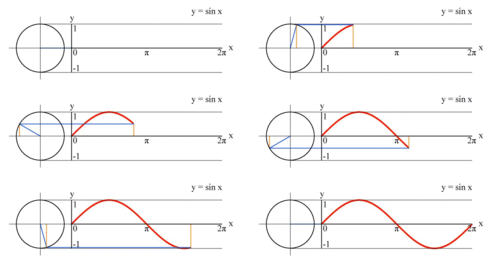
Sine (sin): The ratio of the length of the opposite side to the length of the hypotenuse in a right-angled triangle.
-
Cosine (cos): The ratio of the length of the adjacent side to the length of the hypotenuse in a right-angled triangle.
-
Tangent (tan): The ratio of the length of the opposite side to the length of the adjacent side in a right-angled triangle ($\tan \theta = \frac{\sin \theta}{\cos \theta}$).
-
Cosecant (csc): The reciprocal of the sine function ($\csc \theta = \frac{1}{\sin \theta}$), representing the ratio of the hypotenuse to the opposite side.
-
Secant (sec): The reciprocal of the cosine function ($\sec \theta = \frac{1}{\cos \theta}$), representing the ratio of the hypotenuse to the adjacent side.
-
Cotangent (cot): The reciprocal of the tangent function ($\cot \theta = \frac{1}{\tan \theta}$), representing the ratio of the adjacent side to the opposite side.
-
Hypotenuse: The longest side of a right-angled triangle, located opposite the right angle ($90^\circ$).
-
Radian: A unit of angle measurement based on arc length, where $2\pi \text{ radians} = 360^\circ$ ($1 \text{ radian} \approx 57.3^\circ$).
-
Unit Circle: A circle with a radius of $1$ centered at the origin $(0,0)$ in the Cartesian coordinate plane, used to extend trigonometric functions to any angle.
-
Pythagorean Identity: The fundamental trigonometric identity derived from the Pythagorean theorem, expressed as $\sin^2\theta + \cos^2\theta = 1$.
Industries That Use Trigonometry
-
Architecture & Civil Engineering: Calculates structural loads, roof pitches, bridge support angles, and land slopes to design safe buildings and infrastructure.
-
Aeronautics & Aerospace: Determines flight paths, wind drift angles, satellite orbits, and altitude trajectories for aircraft and spacecraft navigation.
-
Video Game Development & CGI: Renders 3D graphics, calculates character raycasting, models object collisions, and animates realistic movement using vector trigonometry.
-
Land Surveying & Cartography: Measures distances, elevation changes, and geographic boundaries across large areas using triangulation techniques.
-
Acoustics & Audio Engineering: Analyzes sound waves, models frequency harmonics, and designs soundproof spaces using sine and cosine wave functions.
-
Maritime & Ocean Navigation: Computes true heading, compass bearing, ocean current offsets, and celestial navigation coordinates for ships.
-
Electrical & Mechanical Engineering: Models alternating current (AC) voltage waveforms, electromagnetic fields, and rotational forces in motors and machinery.
-
Medical Imaging & Radiography: Reconstructs 3D cross-sectional images in CAT scans and MRI machines by calculating wave projection angles.
-
Astronomy & Astrophysics: Measures interplanetary distances, stellar parallax, and celestial movement relative to Earth.
-
Meteorology & Climate Science: Models global weather patterns, ocean wave dynamics, and solar radiation angles to predict climate and weather systems.
|
Important Trigonometry Historical Events
-
Plimpton 322 Clay Tablet (c. 1800 BC): Records ancient Babylonian mathematical tables containing advanced Pythagorean triples, marking the earliest known use of right-triangle ratios.
-
Hipparchus Compiles First Chord Table (c. 150 BC): Earns the title "Father of Trigonometry" by calculating circle chord values to solve astronomical triangles and track planetary motion.
-
Ptolemy Writes the Almagest (c. 150 AD): Expands chord tables and spherical trigonometry principles, creating a comprehensive geometric framework that dominated astronomy for over a millennium.
-
Aryabhata Introduces the Sine Function (c. 499 AD): Indian mathematician defines jya (half-chord), shifting mathematical focus from full circle chords to the modern concept of sine.
-
Al-Battani and Islamic Golden Age Innovations (c. 900 AD): Islamic scholars formalize tangent, cotangent, secant, and cosecant functions, establishing trigonometry as an independent mathematical discipline.
-
Regiomontanus Publishes De Triangulis Omnimodis (1464): Produces the first European textbook devoted entirely to plane and spherical trigonometry, standardizing trigonometric methods for navigation.
-
Rheticus Defines Ratios on Right Triangles (1596): Defines trigonometric functions directly as ratios of triangle sides rather than circle chords, creating the modern textbook approach used today.
-
John Napier Invents Logarithms (1614): Revolutionizes trigonometric computation by simplifying complex multi-digit sine and cosine multiplications into straightforward addition and subtraction.
-
Leonhard Euler Unifies Trigonometry and Calculus (1748): Introduces standard function notations ($\sin, \cos, \tan$) and formulates Euler's formula ($e^{ix} = \cos x + i \sin x$), connecting trigonometry with complex analysis.
Essential Trigonometry Formulas
-
Pythagorean Identity: $\sin^2\theta + \cos^2\theta = 1$
-
Tangent Identity: $\tan\theta = \frac{\sin\theta}{\cos\theta}$
-
Reciprocal Identities: $\csc\theta = \frac{1}{\sin\theta}$, $\sec\theta = \frac{1}{\cos\theta}$, $\cot\theta = \frac{1}{\tan\theta}$
-
Sine Angle Sum Formula: $\sin(A + B) = \sin A \cos B + \cos A \sin B$
-
Cosine Angle Sum Formula: $\cos(A + B) = \cos A \cos B - \sin A \sin B$
-
Sine Double-Angle Formula: $\sin(2\theta) = 2\sin\theta\cos\theta$
-
Cosine Double-Angle Formula: $\cos(2\theta) = \cos^2\theta - \sin^2\theta$
-
Law of Sines: $\frac{a}{\sin A} = \frac{b}{\sin B} = \frac{c}{\sin C}$
-
Law of Cosines: $c^2 = a^2 + b^2 - 2ab\cos C$
-
Tangential Pythagorean Identity: $1 + \tan^2\theta = \sec^2\theta$
|

 Follow
us:
Follow
us: